Before the Fall: The Palaeolithic Band and the Original Society
Garment and the Skin Essay 4

The Garment and the Skin is an ongoing essay series published fortnightly on Solarpunk Table. It investigates a single question: why does every system human beings build to serve their genuine needs, spiritual, social, economic, creative, eventually end up serving something else entirely? Moving from the Palaeolithic band to artificial intelligence, the series traces one recurring pattern across religion, money, politics, media, and technology: the capture of authentic human experience by institutional power, and its installation inside us as identity. Each essay stands alone but builds on those before it. If you are new here, starting with Essay 1 (The Pattern: One Story, Many Costumes) will give you the full foundation. Otherwise, welcome to wherever you have landed. The thread runs through everything.
On the Palaeolithic band, the reverse dominance hierarchy, and the animist world before the first garment
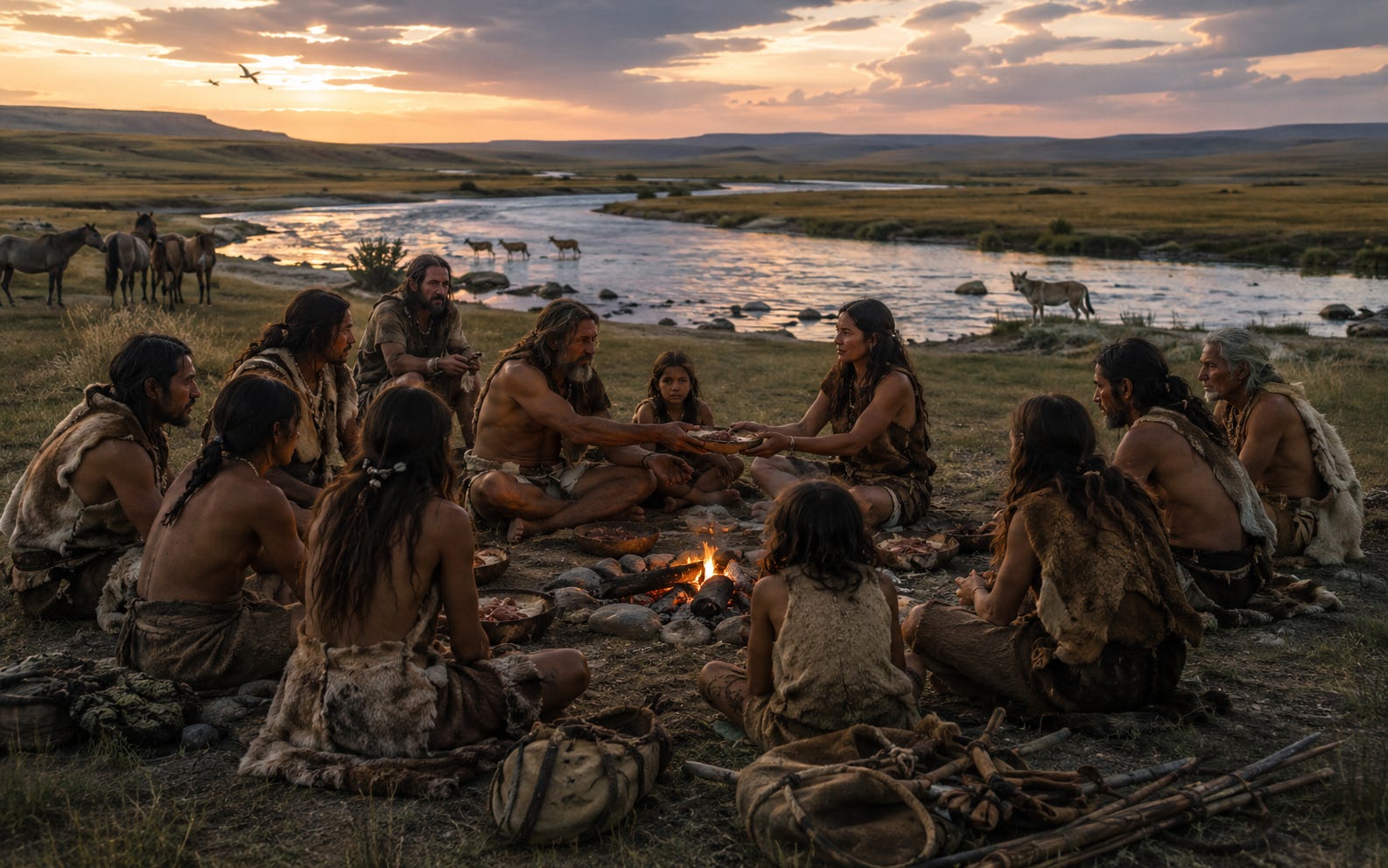
Someone is moving through absolute darkness with a tallow lamp. The year is approximately 36,000 BCE. The ceiling of the cave is thirty feet above them; they know this not because they can see it but because they have made this journey before. They are moving toward a specific wall deep in the interior, where the rock has a quality they recognise and where ordinary consciousness begins to loosen its grip.
They reach the wall. They begin to paint: bison, horses, and a bear, rendered with a startling precision and confidence. Not sketched tentatively. Committed. Exact. The art at Chauvet does not look like someone learning to make pictures. It looks like someone arriving at a destination.
What were they doing?
Not what were they making, and not what did they believe. What were they doing, and what does the answer reveal about the kind of creatures we actually are, before any institution arrived to interpret us to ourselves?
Anatomically modern humans have been on earth for approximately 300,000 years. The nomadic band was the dominant social form for the vast majority of that time, and the cooperative hominin tradition that preceded our species reaches back several million years further. The first cities, the first states, the first temples served by dedicated priesthoods: all of that belongs to the last 5,000 to 6,000 years of this story. Everything this series examines, the capture sequence in its fully developed institutional form, belongs to that last thin edge. This essay is about what was in the rest of it.
Michael Tomasello’s research at the Max Planck Institute identified what may be the most important thing about the human species: what distinguishes us from other great apes is not individual intelligence but the motivation to share experience. A human infant, at around nine months, begins pointing at things. Not to request them. To share attention about them with another person. This is a social act before it is anything else. A chimpanzee infant does not do this. Joint attention and shared intentionality are present before language, before culture, before any institution has had the chance to shape them. Cooperation is not a cultural achievement imposed on a fundamentally competitive nature. It is the biological baseline.
The Taker impulse is also genuinely human. Status-seeking, competitive, dominance-oriented behaviour is present across all primates, and we are no exception. Both impulses came with the package. For most of human history, the question was what the social form did with each of them.
The Reverse Dominance Hierarchy
Christopher Boehm’s research answers this question directly. Egalitarianism in the nomadic hunter-gatherer band is not the absence of hierarchy. It is its deliberate, continuous inversion.
The Taker impulse exists in every band member, as it exists in us. What prevents it from scaling is a specific set of social technologies, maintained without rest. When someone attempts to accumulate more than their share, to elevate themselves through coercion, to claim authority beyond what the community has granted, the community responds.
First: public opinion and gossip. Commentary, observation, immediate and ongoing. The band is small enough that nothing happens anonymously, and everyone knows it. Second: ridicule. Pointed, sustained, socially precise. The person who cannot bear sustained mockery tends to stop the behaviour, because what mockery destroys is precisely what they were trying to accumulate: standing in the community. Third: disobedience. Simply refusing to comply with attempted coercion. Fourth: ostracism. In a community of thirty nomadic people, the withdrawal of social participation is not a minor sanction. Fifth, and deployed rarely: banishment, or in documented cases, capital punishment for individuals who have demonstrated through persistent violent domination that nothing else will reach them.
Boehm notes that band members are continuously vigilant against transgressions of the egalitarian ethos. Not occasionally. Continuously. The egalitarianism is actively maintained, because what it is maintaining against never goes away.
Leadership exists in bands but it is provisional, revocable, and narrow in scope. The moment a leader attempts to convert genuine authority into coercive domination, the community responds with the same mechanisms. This is not the absence of power. It is power held by the many against concentration by the few, which is a considerably more demanding arrangement than any of the political systems that have followed it.
What the band provided within this arrangement: subsistence activities, primarily food acquisition, ran at approximately three to five hours per adult per day in nomadic forager communities. The remaining time was available for ceremony, story, craft, socialising, and rest. Marshall Sahlins’ formulation: affluence achieved by managing what you need rather than maximising what you have. You cannot accumulate what you cannot carry. What you own that you cannot carry, owns you.
On the skeletal record, Palaeolithic nomadic foragers were on average taller, denser-boned, and had healthier teeth than their Neolithic successors. What followed did not improve individual material conditions for the populations who underwent it. It improved the conditions under which surplus could be accumulated by those positioned to do so.
The arrangement worked. It was not Eden.
Interpersonal violence existed, and the skeletal record shows it. The reverse dominance hierarchy was maintained partly through the credible threat of lethal force against persistent violent dominators. These were real people with real darkness, and the mechanisms that managed that darkness were real and not gentle. What is largely absent from the nomadic forager record is organised warfare: coordinated intergroup violence over resources, which correlates strongly with sedentism and surplus. The distinction matters. Individual violence existed. Collective violence over resources was structurally prevented by a condition the band possessed and the settlement does not.
The band’s economic equality expressed the same principle as its political equality. Demand sharing, the norm that anyone who needs may ask and will receive, and the obligation to share the returns of the hunt, kept resource distribution approaching equality. A hunter who attempts to retain the kill for their own family faces the same community mechanisms that prevent political domination. The economic and the political are the same system, enforced by the same tools, expressing the same single principle: what the community generates, the community keeps.
The World That Was Alive
The river has a name. Not a label assigned by a surveyor, but a name in the way that a relative has a name: a recognition of personhood, of presence, of the fact that this entity has its own intentions and its own claims on the world. When you take from it, you take from someone you are in relationship with, which means the taking has conditions. Acknowledgement. Reciprocity. The possibility of refusal.
Extraction in the modern sense, systematic, unconditional, unilateral, does not complete itself in this world. You cannot extract from a relative. The thought dissolves before it arrives.
This is not a romantic account of spiritual belief. It is a precise account of what the new animism scholarship has clarified. Nurit Bird-David, working with the Nayaka of South India, reformulated animism not as the primitive belief that inanimate objects have souls but as a relational epistemology: a way of knowing the world through relationship, in which other-than-human entities are encountered as persons with their own agency and social presence. Graham Harvey’s formulation is the simplest: animism as a way of living in a community of persons, most of whom are other-than-human. Tim Ingold describes it as a condition of being alive to the world, characterised by heightened sensitivity and responsiveness: not a view of the world held from outside it, but a way of being inside it.
The practical implication is not primarily ethical but ontological. In this world, the question of what to do about the river is settled before it is asked. You are in relationship with it. Relationship has obligations. The obligations are not external constraints on your freedom. They are what it means to be a person in a community.
When the river becomes a resource rather than a relative, the logic of extraction becomes available for the first time. Not merely taking from the river, but taking from it without condition, without acknowledgement, without relationship. That turning will come. It is not yet here.
Across a global sample of hunter-gatherer societies, analysed using phylogenetic methods in 2016 by Peoples, Duda, and Marlowe, animism was found to be the oldest recoverable religious trait, present in the most recent common ancestor of all present-day hunter-gatherer peoples. The sequence of religious development runs from animism through belief in the afterlife through shamanism through ancestor veneration and finally to morally active high gods who judge, demand compliance, and require mediation. The God who is always watching, who can only be reached through approved channels, came last. The river-as-person came first. This is not philosophy. It is reconstructed evolutionary history.
I have been to a version of this world: the altered states named in Essay 0 produce a permeability between self and world in which other things acquire presence and agency, and the river-as-relative is not a metaphor you choose but a mode of encounter available to any attentive human nervous system. The institution did not originate this experience. It found it already there.
The Maker’s relationship with their own creative capacity is this same structural orientation: no required intermediary, internal criteria, direct relationship with the work and with the world. The animist world is not a historical curiosity. It is the baseline form of what the Maker orientation looks like when it organises an entire ontology.
The Shaman
The sacred being everywhere does not mean all of it is equally reachable.
Illness has a specific cause in the spirit world that must be found. The animal spirits have intentions about this particular hunt that can be negotiated with. The dead must be managed in their transition. The living world is sometimes signalling something the band needs to understand before it moves. These are the deeper reaches of the same animist territory, the parts that run further than ordinary daily practice can take the average band member. The shaman is not an intermediary between the community and a separate domain. They are a navigator of the same living world, trained to go further into it.
The person with the tallow lamp at Chauvet was this: a direct-experience technician.
David Lewis-Williams’s analysis of what was being done in those deep interior spaces offers the most compelling current interpretation of the visual record. The paintings contain two interrelated elements. The first is geometric: the dots, spirals, grids, and zigzag lines integrated with the animal imagery. These correspond precisely to the entoptic phenomena produced by the human visual cortex in altered states of consciousness, the universal phosphene patterns generated by the nervous system itself, independent of cultural content. They appear in these paintings and in the visionary traditions of indigenous cultures on other continents and in documented altered states today because they are in the hardware: any human nervous system in the relevant states produces them. The second element is the therianthropic figures, entities partly human and partly animal, the boundary between selves dissolving in depth. The positioning of the art deep in caves, where darkness is absolute and the distance from ordinary reality is total, suggests these spaces functioned as membranes between the ordinary world and its deeper reaches. Lewis-Williams’s interpretation is influential and remains contested; the evidence is interpreted rather than self-explanatory. But what it most persuasively suggests is this: what is recorded on these walls is the territory of altered states, entered in service of communal need.
The shaman did not go alone. Ceremony in band communities is participatory. Everyone drums, dances, sings. The shaman goes deeper, but the community has some experiential frame for the crossing. They have been to the shallows of it. The territory is not sealed off. The shaman is a specialist in the crossing, not a gatekeeper of a territory others cannot enter.
And yet the shaman’s role is the band’s first structurally unverifiable claim. Everyone can see whether the hunter shares the kill. The reverse dominance hierarchy can observe a dominance attempt as it happens. But no one can independently verify what the spirits said. The shaman reports from territory only they have reached. The specific encounter is their own.
Joseph Campbell’s distinction matters here, and matters more once the verification problem is named. The shaman’s authority derives from direct experience, continuously renewed. The priest arrives into an institution that precedes them and serves a deity that was there long before they came, in a role institutionally ordained. One is earned encounter. The other is institutional ordination. What Campbell’s distinction describes, beneath the epistemology, is accountability.
Earned encounter means the authority must keep being earned. A shaman whose guidance consistently fails, whose hunts go wrong, whose healings do not hold, loses standing. The same community mechanisms that prevent the Taker from scaling elsewhere apply here. The consequences of the crossing are visible even when the crossing itself is not. It is an authority that can be revoked.
But the exploitation potential is real and documented. Shamanic manipulation appears in the anthropological record: steering community decisions toward outcomes that serve the shaman, performing effects that did not come from the crossing, and claiming encounters that did not happen. This is the Taker impulse finding the band’s most structurally unverifiable position. The mechanisms manage it. The potential is still there.
The shaman occupies the only role in the band whose authority cannot be fully verified by the community in real time, and this makes them the first structural precursor of the capture sequence this series examines. What prevents the capture in the band is the accountability mechanism: the position does not survive the repeated failure of the ability. The priest is what happens when that mechanism is removed, when institutional ordination allows the role to survive the loss of the capacity, when the position is no longer revocable by the community whose needs it was built to serve. The shaman’s authority failing costs the shaman their standing. The priest’s authority failing is explained by the congregation’s insufficient faith.
There is no toll road because there is no road. The sacred is not elsewhere. It is here, available through specific practices of altered consciousness and genuine attention. This will change. But it has not changed yet.
The Trickster
Across many documented nomadic hunter-gatherer cultures, a specific figure appears in story and ceremony: morally ambiguous, greedy, lustful, disruptive, and absolutely necessary. Coyote, Raven, Anansi.
The trickster embodies every impulse the band’s egalitarian ethos requires suppression: the desire to take more than your share, to deceive for personal advantage, to dominate, to be lazy when others work, to want what belongs to someone else. These impulses exist in every band member. The reverse dominance hierarchy prevents their structural expression. The trickster gives them communal form in story.
The community laughs. The laughter is the recognition. Everyone sees themselves in the trickster, because everyone carries these impulses. The Shadow is not denied. It is held communally, processed through story, given a home that belongs to everyone rather than projected outward onto a designated carrier.
In Jungian terms, the trickster is the communal Shadow held safe in story. When the trickster tradition is displaced, as it will be, the Shadow does not disappear. Without its communal home, it becomes available for projection onto designated enemies: the heretic, the witch, the infidel. The institutionalisation of that projection is the scapegoat mechanism, the founding operation of a different kind of social order, in which internal coherence is maintained through the manufacture of external threat. The full development of this belongs to a later essay. For now: the band has a technology for managing human darkness that does not require an enemy. It will not always.
The Exit
This was the dominant human social form for the vast majority of human history. Not a brief experiment. Not a primitive precursor to the things that came later. The arrangement that worked, in documented and evidenced ways, for hundreds of thousands of years.
The first garment has not been made yet. The observer whose gaze the garment is designed to satisfy has not arrived. What is here is the long baseline before the measurement was taken. The egalitarian band, the animist living world, the shaman who goes and returns, the trickster who holds the Shadow communally in story, and the one structural condition that makes all of it possible: the option to go somewhere else.
Fission was the band’s final recourse. When internal conflict could not be resolved through gossip, ridicule, disobedience, ostracism, or expulsion, the band split and moved in different directions. What you owned had to fit in your hands. What you feared had to be survivable in open country. The Taker impulse was present in every band member, genuinely and persistently, but it could not scale: there was nothing to accumulate, nowhere to hold it, no way to compound it across seasons. And if someone tried, you could leave.
One thing is coming that changes this. Not a person, not a decision, not a failure of the human moral imagination. A change in what is structurally possible. An abundance that, for the first time, can be stored, held in one place, compounded over seasons and years. When that appears, the exit option begins to close.
Essay 5 goes to the Neolithic transition: the surplus that appears for the first time, the fixed settlement that removes the exit option, and the conditions under which the Taker impulse can, for the first time in the long human story, scale. The world before the first garment ends here. The next essay shows who starts taking measurements.
The thread runs through everything.
Check out our sister publication:
Signal Dept is a fortnightly zine for electronic music that the algorithm is unlikely to surface on its own. Each edition contains Signal Scan, five selections from the playlist presented without scores or rankings, and a feature essay on some aspect of how this music gets made, heard, and circulated. The playlist runs on YouTube and one track at a time gets broadcast across social media, human-selected, almost every day. If you are reading this for the first time, that is where to start. If you have been here before, welcome back. There is always more signal.
The zine publishes here on Substack every 2 weeks. The playlist lives on YouTube and is updated as I find new music to add.`